
盾牌
张韶涵演唱会突发心脏不适 短暂休整后坚持完成演出_我的网站

A |
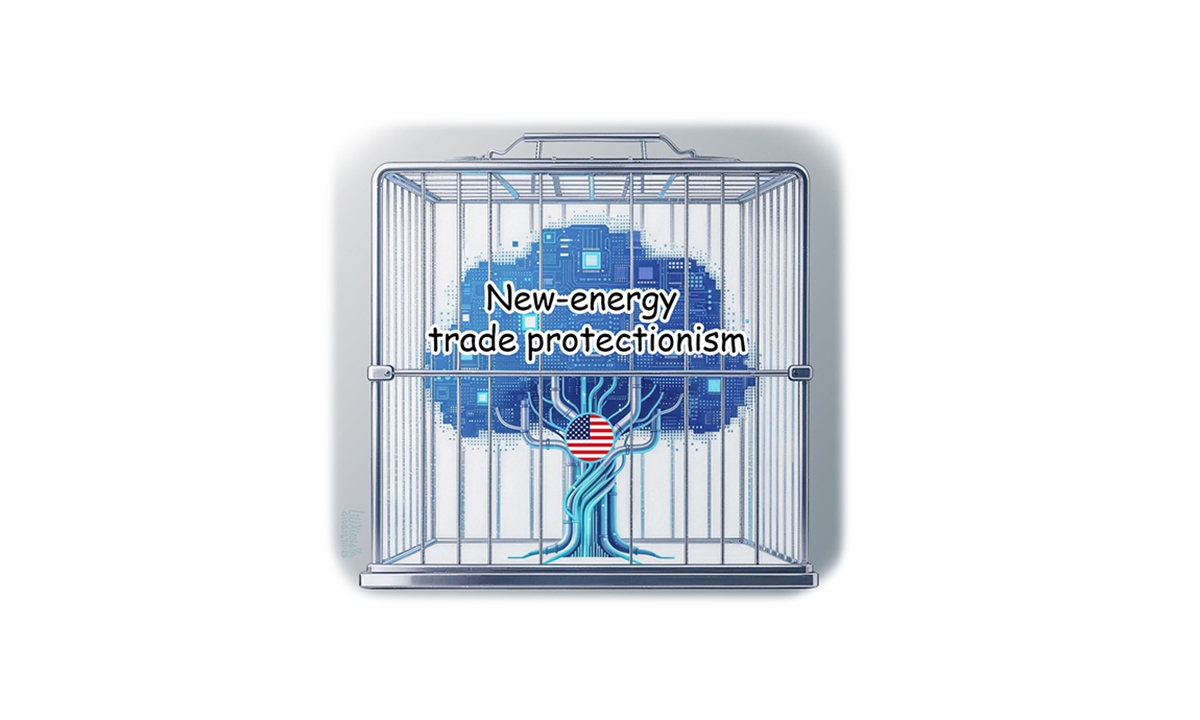
Recent media reports have questioned whether a natural gas plant built to power an Amazon data center project in Texas could become the largest climate polluter in the US. The controversy, whatever the eventual outcome, offers a reality check for America's artificial intelligence (AI) drive.
It exposes a growing contradiction: The US is racing to expand its AI capabilities, yet its protectionist trade policies are making it harder and more costly to access some of the clean-energy technologies needed to sustain that expansion. This raises a broader question: Can an energy-intensive AI race afford the costs of renewable energy protectionism?
The US is entering a new era of rising electricity demand. Data centers, the backbone of the AI economy, are emerging as one of the fastest-growing sources of power consumption. Much of that demand is still being met by fossil fuels: The International Energy Agency reports that natural gas supplies more than 40 percent of the electricity used by data centers in the US, making it their largest source of power.
So, it's not surprising that the expansion of data centers has raised concerns over their environmental impact and the pressure they could place on local power systems and electricity bills. A Gallup survey conducted in March found that seven in 10 Americans opposed the construction of AI data centers in their local area, including 48 percent who strongly opposed such projects.
The findings point to a broader challenge for the US: The race to develop AI is increasingly becoming a race to meet growing energy needs. Addressing this challenge will require more than advances in computing technology; it will also depend on an energy system capable of delivering large amounts of reliable, affordable and cleaner power. That, in turn, will require faster development and broader deployment of clean-energy technologies, from solar power to energy storage.
Yet in the clean-energy sector, the US has increasingly relied on protectionist trade measures that limit access to cost-competitive products from global markets. The country has placed greater emphasis on expanding domestic manufacturing capacity, but rebuilding entire clean-energy supply chains at home is a costly and time-consuming process. Even if expanded domestic production is achieved, it is likely to come at a higher cost, making the deployment of renewable technologies more expensive and potentially slower.
The solar industry offers a clear illustration of this policy direction. The US has continued to expand trade barriers in the sector. Reuters reported that the US government announced on Thursday a series of price floors and a 15 percent tariff on products made from polysilicon, a raw material used in solar panels.
The challenge lies in the limited scale of the US polysilicon industry. Reuters reported that the country has two polysilicon factories. Against this backdrop, relying on domestic polysilicon production while restricting access to imports runs counter to the goal of expanding solar power in the US. The country risks creating barriers that ultimately constrain its own access to the global supply chains needed for growth.
The pressing issue for the US is the speed at which new power demand is emerging. The expansion of data centers is creating electricity needs that cannot wait for domestic clean-energy capacity to develop gradually. Global supply chains can provide the scale and speed required in the near term. By narrowing access to these sources, the US risks turning clean-energy policy into a drag on the infrastructure needed for its AI race.
The US has placed AI high on its economic and technological agenda. The outcome of this race will matter greatly, as financial markets are also watching whether America can turn its AI efforts into commercial success.
This leaves the US with a difficult choice: Can it afford the cost of clean-energy protectionism while racing to build AI infrastructure? The answer may be no. Trade barriers that limit access to competitive renewable technologies could ultimately become a constraint on the AI expansion that Washington is seeking to accelerate.
The author is a reporter with the Global Times. [email protected]
。

B | 8月23日晚,张韶涵“玩家”巡回演唱会成都站演出突发意外。本场为该巡演第二场,张韶涵因现场高温、加之身着沉重的“木马”造型演出服,心脏负荷过大出现身体不适。舞台画面随即打出“对不起,请给我三分钟”字幕,演出临时暂停。现场医护人员迅速登台,为其测血压、物理降温并吸氧救治。全程休整仅3至5分钟,张韶涵因身体不适落泪,不少观众起初误以为是舞台效果。状态稍有恢复后,她含泪返场,并向观众致歉,解释身体不适原因,坦言不愿让观众看到自己脆弱的一面,同时暖心安抚歌迷,承诺身体不适会及时叫停演出,并带动全场大合唱平复现场气氛。后续演出中,张韶涵稳定发挥,完整完成《大小孩》《隐形的翅膀》等曲目表演,安可环节全程保留,未因突发状况缩水演出,敬业表现获现场观众认可。

C | 演出结束后,张韶涵发文报平安,表示本场配有专业医护团队全程值守,事后已完成全面身体检查,身体一切安好,同时感谢观众与工作人员的关心和包容。

D |
Current article:http://4qp.jueniaolunhuaishewo.cfd/koz/20260826/14775.html
Published on:15:49:51